Blog
Beyond Rule-Based Automation: The Enterprise Guide to AI Decisioning and Real-Time Orchestration
Written by Sohum Bajaj
Learn how to move beyond rule-based automation. Discover how AI decisioning and real-time orchestration drive algorithmic personalization and better CX.
What Is AI Decisioning in Marketing?
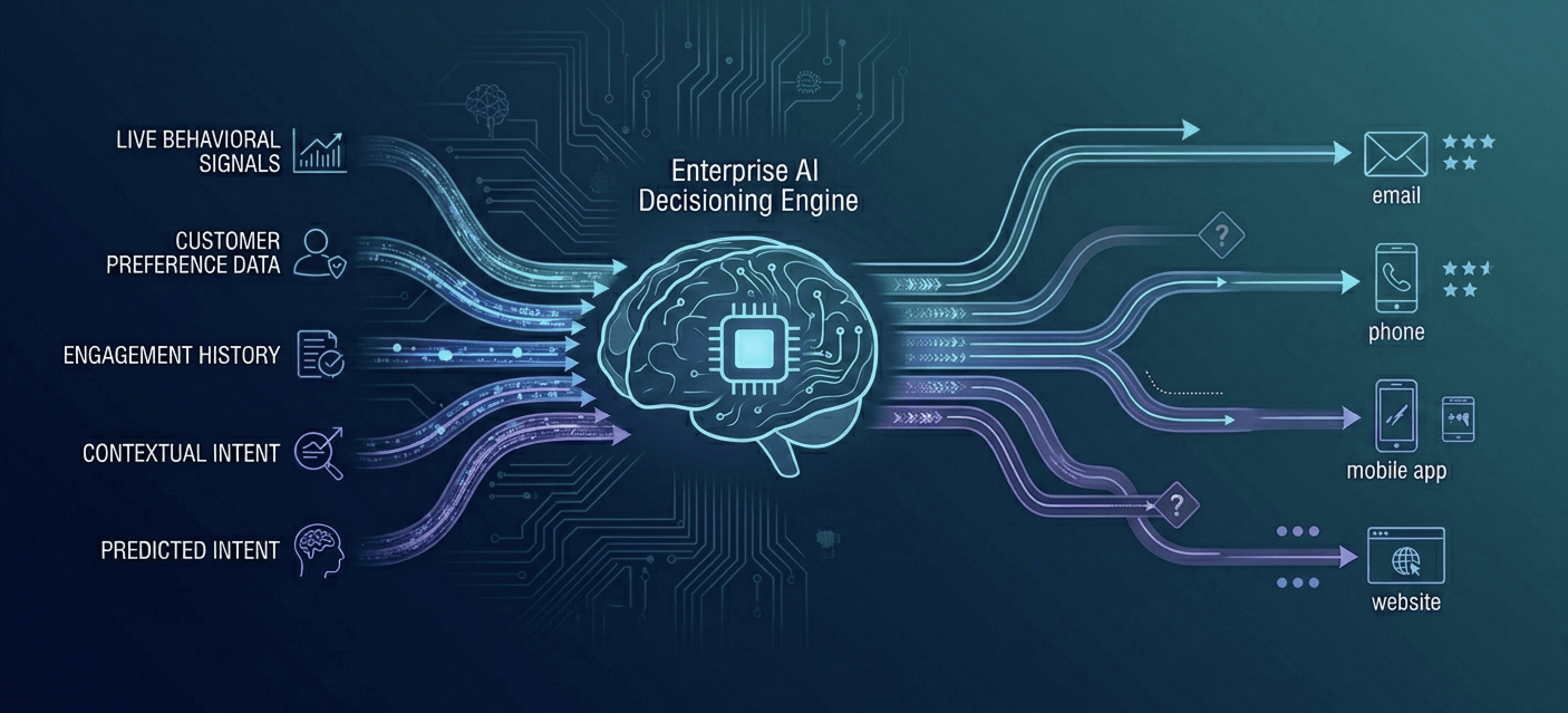
AI decisioning in marketing is defined as the practice of using machine learning models to autonomously determine the best action to take for each individual customer, in real time, without human intervention. Where traditional automation executes a predetermined script, AI decisioning reads live behavioral signals and adapts on the fly.
The distinction matters more than most teams realize. Rules-based automation operates on fixed logic: if a user does X, send Y. That's a powerful starting point, but it's fundamentally static. AI decisioning flips the model entirely. Instead of following instructions, the system figures out the optimal action based on current context: channel preference, engagement history, predicted intent, and timing, all resolved in milliseconds.
This shift moves enterprise marketing away from campaign-centric calendars toward always-on, customer-centric decisions that respond to each person's behavior as it happens. A journey orchestration platform refers to software that constructs the most relevant customer path dynamically, at the individual level, across every touchpoint, powered by AI decisioning rather than pre-built flows.
Think of it this way: AI decisioning is the brain that decides what message to send, to whom, on which channel, at exactly the right moment, autonomously.
Key Takeaways
AI decisioning uses machine learning to autonomously choose the best message, channel, and timing for each customer in real time, replacing static rules with live signal-driven decisions.
Traditional A/B testing is too slow, too complex, and too dependent on human intuition to scale with modern lifecycle marketing demands.
Multi-agent architecture, with specialized Strategy, Creative, Decisioning, and Data agents, outperforms single-model approaches by letting each agent focus on one task.
Reinforcement learning (Weighted Thompson Sampling) optimizes campaigns continuously during execution, not after, eliminating the revenue lost to losing variants.
Enterprise results include Notion's 96% lift in CTRs, ClickUp's +89% create view rate across 300+ segments, and Outschool's +33% lift in purchase membership rate.
JustAI differs from Braze and Iterable in that it generates creative, makes decisions, and optimizes autonomously; marketers don't build the journeys.
Integration takes 30 minutes to one week, with plug-and-play support for most major ESPs and Reverse-ETL tools.
Why Traditional A/B Testing Breaks at Scale
As outlined above, AI decisioning replaces static rules with real-time, model-driven choices. But to understand why that shift matters, it helps to see exactly where the old approach collapses, and it collapses in three predictable places.
The Speed Problem
Traditional A/B testing operates on a timeline that customer behavior simply doesn't respect. A standard test cycle (hypothesis, setup, traffic split, statistical significance) routinely takes two to four weeks. Meanwhile, a customer who browsed a pricing page on Monday, ignored a nurture email on Wednesday, and downgraded their plan on Friday has already made their decision. Next best action marketing is defined as a real-time decisioning approach that determines the most relevant action for each customer at each moment, demanding a response in hours or minutes, not weeks.
The Complexity Wall
Lifecycle journeys don't stay simple. A single onboarding flow branches into segments by plan tier, engagement score, industry, and channel preference. Add re-engagement, expansion, and winback motions, and a modest CRM program can generate hundreds of distinct paths. No team can manually configure, monitor, and optimize that volume of branches without cutting corners.
Intuition Over Signal
Most A/B testing programs are built on instinct dressed up as methodology. A marketer picks two subject lines based on what feels right, runs the test, and calls the winner, without accounting for recency, behavioral context, or which customer cohort is actually responding. Decision intelligence for CRM refers to the application of AI and machine learning to replace intuition-based marketing decisions with continuous, signal-driven learning that compounds over time.
The Gap JustAI Identified
The JustAI team observed this directly while working inside high-growth companies, watching smart, well-resourced marketing organizations hit the same ceiling: rules too rigid, tests too slow, and data too fragmented to act on coherently. Recognizing that gap is what led to a fundamentally different architecture, one where specialized agents handle each part of the decisioning problem in parallel.
How Multi-Agent AI Decisioning Works
The Four-Agent Architecture
JustAI's approach centers on a multi-agent architecture where four specialized agents work in coordinated sequence, each optimized for a distinct function within the campaign lifecycle.
Strategy Agent: Analyzes audience data, campaign history, and business objectives to determine what should be communicated, to whom, and when.
Creative Agent: Generates and assembles message variants: subject lines, body copy, calls to action. Rather than a marketer writing five variants to test, this agent produces and manages creative at a scale no individual contributor can match.
Decisioning Agent: The core marketing decisioning engine, defined as the system that evaluates available variants and real-time user signals to select the optimal message for each individual at the moment of send.
Data Agent: Closes the loop. Captures response signals (opens, clicks, conversions, downstream behavior) and feeds them back into the system so every subsequent decision is informed by fresh evidence.
A Closed Loop, Not a Linear Process
What makes multi-agent coordination powerful isn't just the specialization; it's the handoff structure. Each agent passes enriched context to the next, creating a feedback loop that tightens with every campaign cycle. A campaign launched on day one is meaningfully smarter by day seven, without a marketer touching it.
Why Specialization Outperforms a Single Model
A single monolithic model asked to plan strategy, write copy, make real-time decisions, and ingest performance data is doing too many jobs simultaneously. Specialization allows each agent to be trained and tuned for its specific task, improving accuracy at every stage. This is fundamentally different from adding an AI recommendation layer on top of a rules-based journey builder.
The Learning Engine: Reinforcement Learning and Thompson Sampling
The Multi-Armed Bandit Problem in Marketing
The multi-armed bandit problem is defined as a classic optimization challenge where a system must balance exploiting what's already working against exploring alternatives that might perform better. In marketing, every campaign decision is a version of this problem. Traditional A/B testing resolves it by splitting traffic evenly and waiting weeks for significance. The cost? Every message sent to the losing variant represents real revenue left behind.
Weighted Thompson Sampling
Weighted Thompson Sampling is defined as a reinforcement learning algorithm that maintains a probability distribution for each creative variant and updates it continuously as new engagement data arrives. Variants that perform better receive more traffic, proportionally more, while lower-performing options remain in rotation to keep learning. The result is a system that optimizes during a campaign, not after it.
Disjoint Linear Thompson Sampling
The best subject line for a power user isn't necessarily the best for someone on day two of their trial. Disjoint Linear Thompson Sampling refers to a variant of Thompson Sampling that models performance at the individual segment level; each user cohort gets its own probability distribution, allowing the system to personalize at a granular level.
LLM Auto-Tune: The Self-Improving Loop
When performance data signals that existing variants are plateauing, LLM Auto-Tune generates new creative options guided by that same performance signal. It's not random variation; it's informed generation. The system identifies what's working, extrapolates from it, and tests new directions automatically. Campaigns get measurably stronger every day without manual intervention.
AI Decisioning vs. Traditional Marketing Platforms
Capability | Rules-Based Platforms | AI Decisioning |
|---|---|---|
Campaign logic | Static, manually defined | Dynamically generated and updated |
Personalization depth | Segment-level | 1-to-1 individual |
Optimization cadence | Manual A/B test cycles | Continuous, autonomous |
Response to real-time behavior | Delayed or rule-triggered | Immediate, probabilistic |
Scalability | Linear: more rules = more work | Exponential: improves as data grows |
Cross-channel coordination | Siloed by channel | Unified from a single decisioning layer |
AI decisioning doesn't deprecate your existing channels or sending infrastructure. It sits above them as an orchestration layer, determining what message, channel, timing, and creative variant each individual receives, then dispatching those decisions downstream to execute.
Real Results: Enterprise AI Decisioning in Action
Coursera and ClickUp: Personalization at a Scale That Wasn't Possible Before
Coursera deployed JustAI's AI-native decisioning system to scale lifecycle personalization across a learner base that would break any manually managed workflow. No team can author, test, and optimize individualized messaging at the volume Coursera's audience demands. AI decisioning removed that ceiling.
ClickUp personalized lifecycle messaging across 300+ segments for new user activation, achieving a +89% lift in create view rates, a result impossible to maintain with any consistency manually. With JustAI, ClickUp ran coordinated activation sequences across those segments without the operational overhead that would normally require a dedicated team of campaign managers.
Lemonade, Notion, and Thumbtack: Measurable Outcomes
Lemonade brought AI-speed responsiveness to insurance marketing, an industry where conversion windows are narrow and timing is everything. By optimizing in real time rather than in weekly review cycles, Lemonade achieved double-digit CTOR lifts in ways that rules-based tools structurally cannot replicate.
Notion tested over 100 content variations autonomously, without requiring a human to brief, build, or approve each variant. The result: a 96% lift in CTRs across campaigns.
Thumbtack's story adds an important dimension. Early results showed strong CTR improvements, but the more meaningful evolution came when measurement shifted toward actual revenue impact. Real AI decisioning optimizes toward outcomes, not proxies.
Outschool and BiggerPockets: Scaling the Long Tail
The pattern holds beyond the headline names. Outschool deployed AI decisioning to scale personalized lifecycle messaging across an education marketplace with highly fragmented learner intent, achieving a +33% lift in purchase membership rate. AI decisioning handled the complexity automatically, replacing manual segmentation that would require constant maintenance as learner preferences shift.
BiggerPockets faced a similar challenge: a large, engaged audience with varied investment interests, where the right message for a rental property investor differs significantly from one targeting a passive REIT investor. Instead of maintaining dozens of campaign branches, AI decisioning determined the optimal message and timing for each member based on their specific behavioral signals, delivering a 44% gain in paid subscriptions.
The Compounding Effect
What these case studies share is not a one-time lift; it's compounding improvement. Each campaign cycle produces signal that makes the next cycle smarter. Notion's 96% CTR lift wasn't the result of a single well-timed campaign; it was the cumulative outcome of a system that ran, learned, and improved continuously over time. This compounding effect, where results improve without additional human effort, is the defining commercial advantage of genuine AI decisioning over rules-based alternatives.
How to Evaluate an AI Decisioning Platform
Seven questions cut through the noise when evaluating your options:
Does it run end-to-end autonomously? If it only surfaces suggestions, it's a decision-support tool, not a decisioning engine.
How fast does integration actually take? Look for systems designed to connect within weeks, not quarters.
Does it generate creative, or just optimize it? Platforms with multi-agent architecture can produce and test messaging autonomously.
Can it personalize at the individual level? Confirm whether the platform's learning model operates per-user or per-cohort.
What channels does it coordinate across? Genuine orchestration means coordinated decisioning across email, push, SMS, in-app, and beyond.
Does it get smarter without manual retraining? Reinforcement learning is only valuable if the feedback loop is continuous and automatic.
What enterprise proof exists? Named customers with measurable outcomes: results from Coursera, ClickUp, Lemonade, Notion, and Thumbtack demonstrate what production-grade AI decisioning delivers.
AI Decisioning Tools and Platforms
The AI decisioning market has matured rapidly, but platforms differ significantly in architecture and what "AI" actually means under the hood. Understanding the landscape helps enterprise teams avoid choosing a tool that adds sophistication at the interface level without changing anything structurally about how decisions get made.
JustAI
JustAI (getjust.ai) is built from the ground up as an autonomous decisioning system. Four specialized agents (Strategy, Creative, Decisioning, and Data) work in coordinated sequence to run campaigns end-to-end without manual input. The reinforcement learning layer, Weighted Thompson Sampling, continuously reallocates traffic toward better-performing variants during a campaign, not after it. JustAI integrates with existing sending infrastructure rather than replacing it, typically deployable on top of most enterprise martech stacks within 30 minutes to one week.
Braze and Iterable
Braze and Iterable are the market's dominant execution platforms. Both have added AI features (Braze with Journey AI and predictive capabilities, Iterable with Brand Affinity and predictive goals), but the underlying architecture remains marketer-defined. A human still builds the journey, writes the copy, and defines the decision points. AI assists rather than decides. At scale, the operational overhead of managing complex branching campaigns doesn't disappear when AI is advisory rather than autonomous.
Movable Ink and Adobe Journey Optimizer
Movable Ink specializes in dynamic content personalization at the asset level, personalizing images, offers, and content blocks within messages sent by another platform. Adobe Journey Optimizer is a full-stack journey orchestration layer inside the Adobe Experience Cloud, best suited for organizations deeply embedded in that ecosystem. Both address different layers of the decisioning problem than a purpose-built AI decisioning engine.
The Key Distinction
When evaluating platforms, the critical question is whether AI is making the decision or informing it. Platforms where marketers still define rules, build flows, and approve variants are decision-support tools. Platforms where agents autonomously determine actions, generate creative, and optimize in real time are decisioning engines. The former scales linearly with your team size. The latter scales independently of it.
Frequently Asked Questions About AI Decisioning
What is AI decisioning in marketing?
AI decisioning is defined as the use of machine learning to autonomously determine the best message, channel, and timing for each individual customer in real time. It differs from rules-based automation in that it doesn't follow predetermined logic; it reads live behavioral signals and adapts continuously without human intervention.
How is AI decisioning different from traditional marketing automation?
Traditional marketing automation refers to systems that execute fixed rules a marketer defines in advance: if X happens, send Y. AI decisioning replaces those rules with a model that determines the optimal action dynamically, based on each customer's current context. The practical difference is that automation scales linearly with the number of rules you can maintain, while AI decisioning scales with data; it gets smarter automatically as more signals accumulate.
What is the multi-armed bandit problem in marketing?
The multi-armed bandit problem is a classic optimization challenge: how do you balance exploiting what's already working (sending the best-known message) against exploring alternatives that might work better? Traditional A/B testing solves this poorly; it splits traffic evenly and waits weeks for results. Thompson Sampling solves it continuously, reallocating traffic toward better-performing variants in real time throughout the campaign.
What is Thompson Sampling?
Thompson Sampling is a reinforcement learning algorithm that maintains a probability distribution for each variant being tested and updates it as new data arrives. Variants that perform better receive proportionally more traffic, not through a binary winner/loser split, but through continuous reweighting. The result is an optimization process that runs during a campaign rather than after it, eliminating the revenue cost of routing traffic to underperforming variants.
How long does AI decisioning take to show results?
Most teams see measurable lift within the first campaign cycle. Because Thompson Sampling optimizes in real time, the system doesn't need to wait for statistical significance before shifting toward better-performing variants. Compounding improvement, where each cycle produces signal that makes the next cycle smarter, typically becomes visible within 30 to 60 days of consistent deployment.
What data does an AI decisioning engine need to work?
At minimum: behavioral signals (opens, clicks, conversions), channel preference data, and basic customer attributes (plan tier, lifecycle stage, engagement history). The more signal available, the more precisely the system can personalize. JustAI integrates with most major ESPs and Reverse-ETL tools to pull this data without requiring custom engineering work.