Case study
How Speak Drives Double-Digit Relative Lesson Completions with JustAI
Written by JustAI Team
How a language-learning app made daily reminders more personal, with relative lifts in lesson-completion rate of 15.5% in Japan and 12.3% in Korea.

Speak is a language-learning app that helps people build confidence in a new language through speaking lessons and conversations with an AI tutor. Its team uses push notifications to help learners keep practicing, whether they are starting a new lesson or returning after a few days away. Making that invitation relevant means adapting the wording to the learner’s language and progress.
Behind each short reminder was a complex setup. Speak maintained variations across languages and stages of the learner journey, storing the copy in a spreadsheet while Customer.io handled the data lookups, timing rules, and sends. Introducing a new message meant working within that existing system, which made it difficult for the team to keep adapting reminders to different learners.

Speak used the spreadsheet to organize reminders, storing each message’s title, body, reminder type, and timing in a separate row.
JustAI helped Speak turn those ideas into hundreds of personalized push messages and send more of the ones that led to a finished lesson. The team could see which wording worked in each market, then build on it. Japanese daily reminders delivered a 15.5% relative lift in lesson-completion rate; Korean reminders delivered 12.3%.
More personal reminders, less manual setup
The spreadsheet was only part of the work. Each message also had to reach the right learner through Customer.io.
The old Customer.io journey repeated data lookups, copy updates, quiet-hour rules, and sends across separate branches. It pulled message variations from a static spreadsheet, so new wording had to be kept in sync with the right language and journey day. That made even a small change laborious.
Before: repeated setup across branches

Speak’s previous Customer.io flow, supplied by the team.
The team could now create variations for a learner’s language, country, and progress without maintaining a separate branch for every message. In Studio, messages could combine the learner’s name and learning language with different prompts for each journey day. Customer.io retained the rules for when a notification could be sent.
After: reminders shaped around each learner
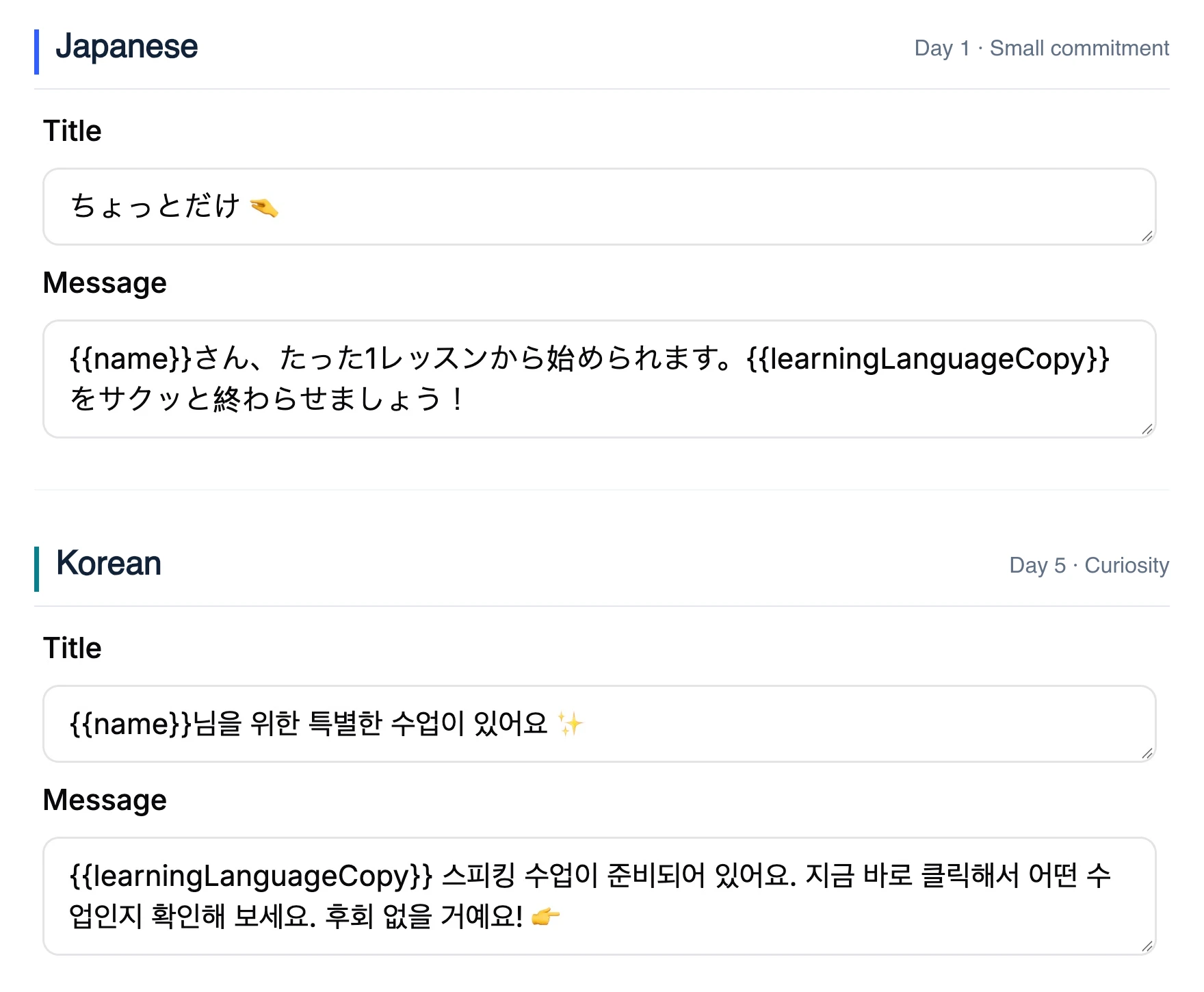
Two daily reminders in JustAI Studio: a Japanese day-one invitation to start with one lesson and a Korean day-five invitation to discover a speaking lesson. The placeholders represent the learner’s name and learning language. Language and tone labels added for clarity.
As learners responded, JustAI adjusted how sends were distributed in real time. Messages that performed better against the lesson-completion goal received more upcoming sends, while new variations continued to get a chance. Those results also gave Speak’s team ideas for what to write next.

Japanese daily reminders, filtered to day four, May 5 to September 12, 2026. Each color represents a message variant’s share of daily sends, showing how the mix changed over time.
🇯🇵 Japan: encouragement brought learners back
For Japanese learners on day four, Speak tried two different invitations to return. One pointed out an unfinished lesson. The other addressed the learner by name and said, “You can do it!”
“Your previous lesson is unfinished” was the weakest day-four message. The encouraging message lifted open rate 37% over the baseline. The difference gave the team a practical direction for new variations: make returning feel achievable, rather than remind learners of what they had left undone.

Two Japanese day-four messages. The encouraging version lifted open rate 37% above the day-four baseline; the unfinished-lesson version performed below that baseline.
A familiar proverb, 継続は力なり (“perseverance is power”), was one of Japan’s weakest daily reminders. It sounded local, but could have been sent to anyone. The stronger day-four copy named the learner and offered reassurance. Speak had a more personal starting point for new messages: acknowledge the learner and make the next lesson feel achievable.
Across the full Japanese daily-reminder campaign, Speak achieved a 15.5% relative lift in lesson-completion rate. This campaign-level result is separate from the individual messages’ open-rate lifts.

Japanese daily reminders, May 5 to September 12, 2026. Campaign-level relative lift.
🇰🇷 Korea: a direct reminder or a small challenge
In the Korean day-four reminders, a direct message performed well. “[Name], you haven’t opened the app in four days” lifted open rate 42% over the original “Shall we restart your English journey?” In this reminder, naming the time away gave learners a more concrete prompt to return.
For learners inactive for five days, the variations explored a different choice: remind them of their past effort, or offer a small challenge. “Can you get this answer right?” beat “It would be a shame to waste the effort you’ve put in” by 30% on opens and 11% on lesson starts. The quiz gave them something immediate to engage with.
Learners could also see the messages change over time. A Korean marketing creator who documented a week away from Speak received a low-pressure invitation to do one short lesson, then a prompt to hear how an expression sounded. Each offered a different reason to open the app. This was one learner’s observed journey, rather than a fixed sequence for everyone.
After continued inactivity, the tone softened again: “This probably isn’t a good time to send another notification.”
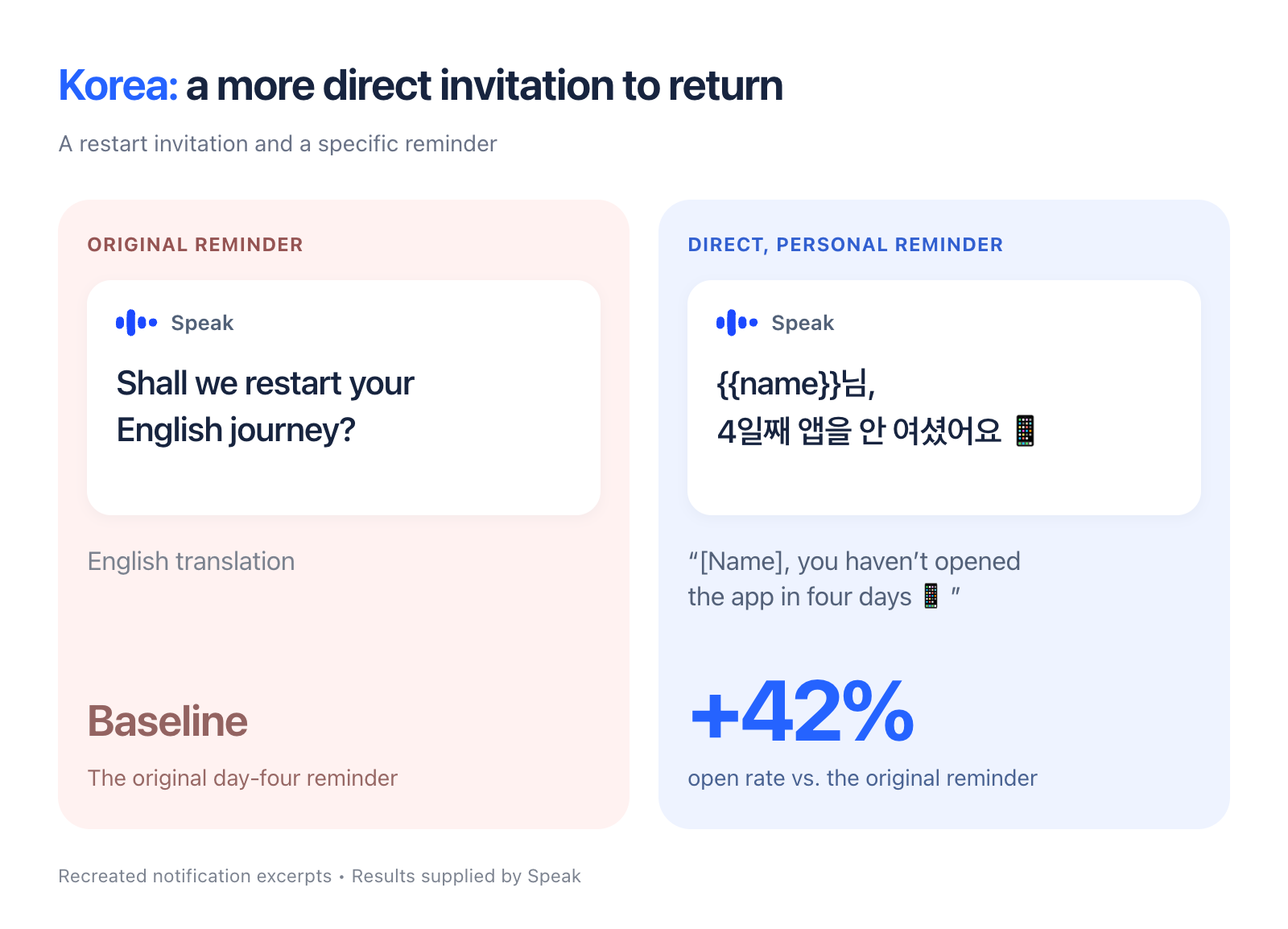
Korean day-four reminders: the direct message lifted open rate 42% over the original. Notification excerpts recreated from Speak’s examples; English translations are provided for context.
The Korean daily-reminder campaign achieved a 12.3% relative lift in lesson-completion rate.
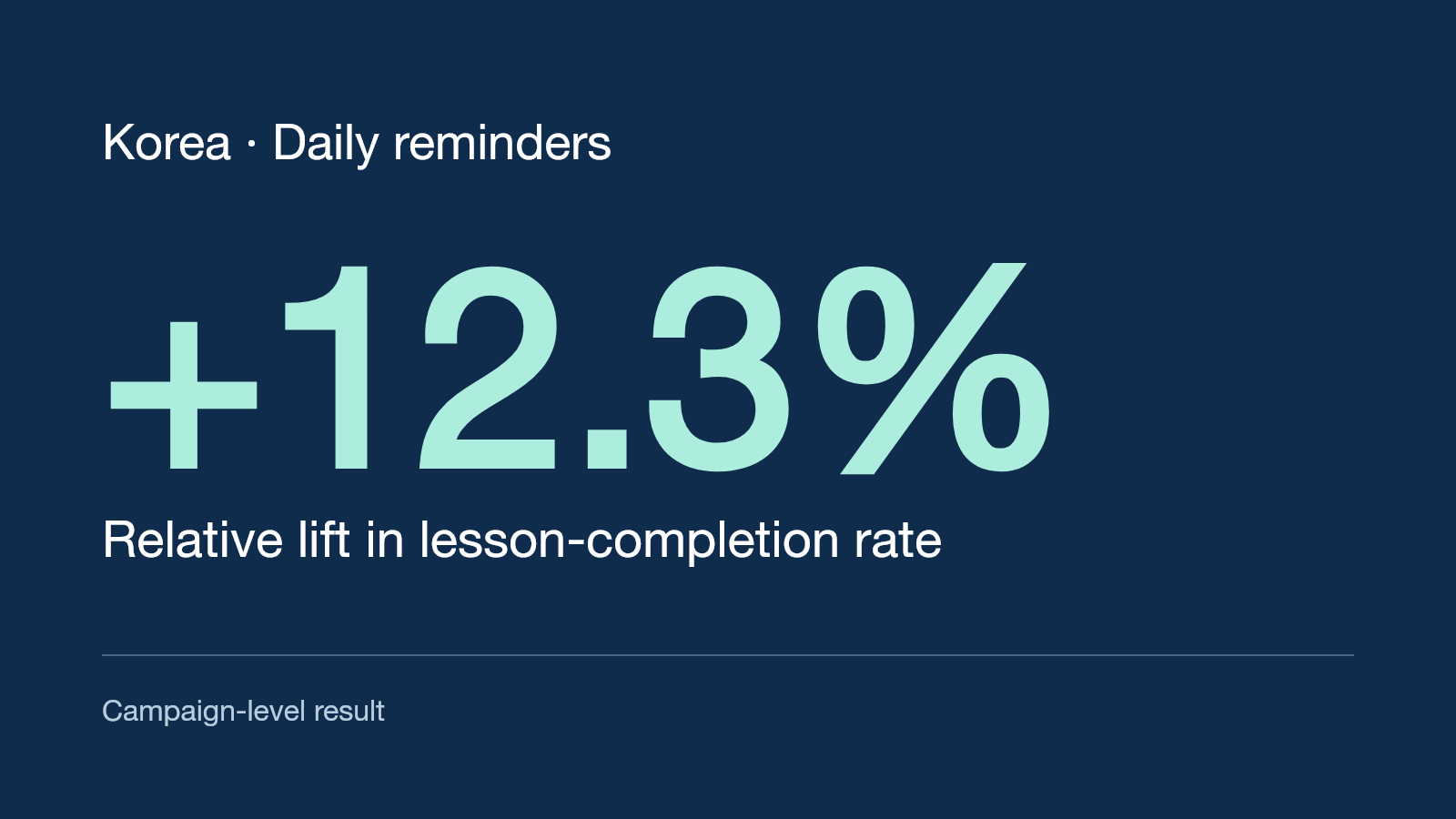
Korean daily reminders, May 5 to September 12, 2026. Campaign-level relative lift.
A reason to start: 19.46% lift in onboarding
Speak used the same ability to create variations earlier in the learner journey. Before someone had finished a first lesson, the starting point was the reason they had signed up.
With roughly ten motivation groups, including career, social connection, education, culture, travel, and self-improvement, the team could develop an invitation around each learner’s goal.
“Your first conversation starter” offered a way into smoother chats. “Your next interview starts here” connected the same first lesson to a work goal. Both messages made the next step specific to what the learner wanted to do.

Actual Social and Career onboarding copy and audience labels, presented in an editorial layout. Relative lesson-completion lifts are reported below.
Across English onboarding, Speak recorded a 19.46% relative lift in lesson-completion rate. One Social variant achieved a 47.67% relative lift in lesson-completion rate. That individual result covered April 13 to June 18, a different period from the campaign aggregate.

English onboarding, April 8 to September 12, 2026. Campaign-level relative lift, separate from the Social variant above.
A better reason to return, in every language
Daily reminders now span four languages, alongside onboarding for roughly ten learning motivations. Speak can turn more of its learner knowledge into messages, see how people respond, and keep improving the next invitation to practice.
Credit goes to Torey Klucznik and the Speak team for the learner insights, local knowledge, and creative ideas behind these journeys. With JustAI handling message creation and allocation at scale, more of those ideas could reach learners in the next push notification.
Conversion in the campaign results means a finished lesson. All performance gains are relative lifts, not percentage-point changes. Individual-message open and lesson-start lifts are labeled separately and use their own baselines. Results reflect the reporting periods shown; English translations are provided for context.