Blog
Beyond the Click Factory: The 2026 Guide to Agentic Lifecycle Marketing Automation
Written by Sohum Bajaj
Move beyond basic triggers. Discover how autonomous AI agents for lifecycle marketing automation drive 1-1 personalization and complex customer orchestration.
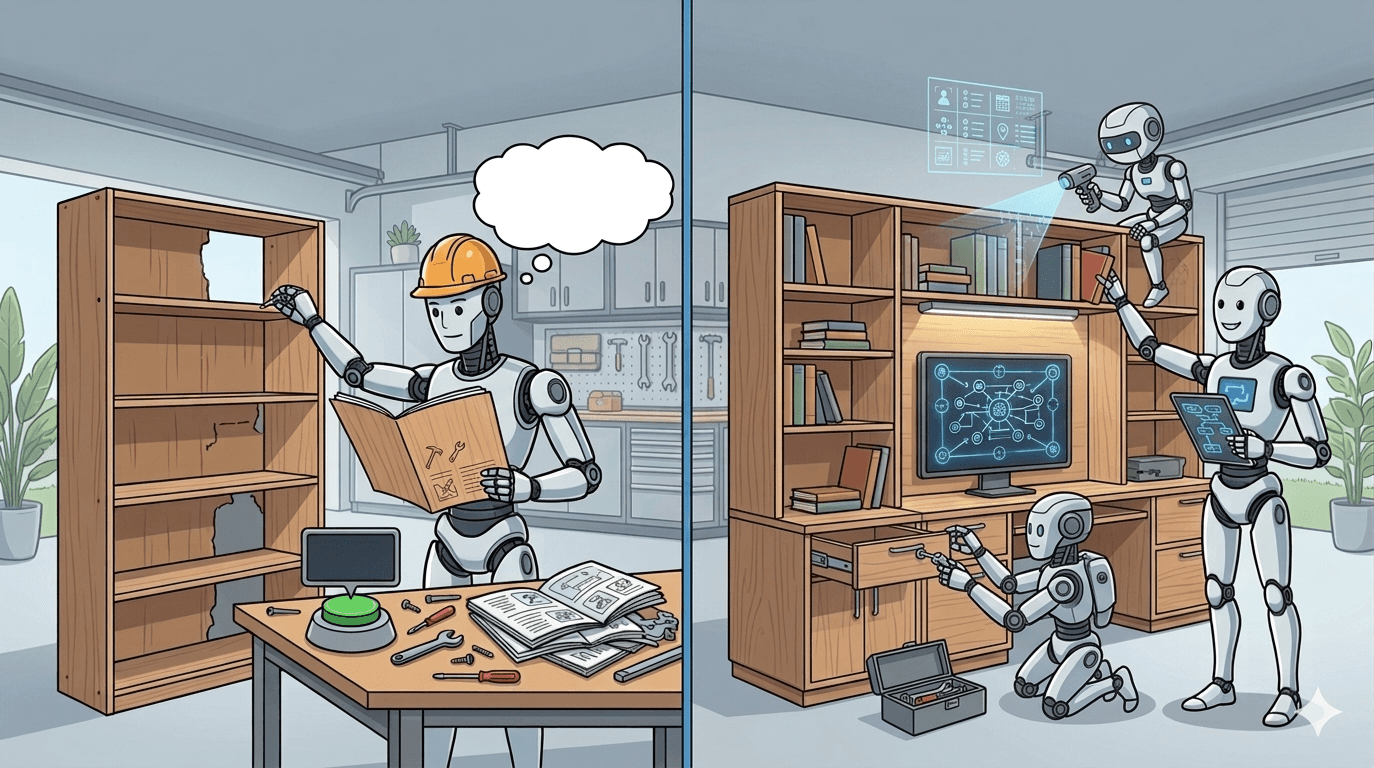
The Death of the Trigger: Why 2026 is the Year of Agentic Marketing
Marketing automation has run on the same logic for over a decade: if this happens, do that. A contact opens an email, trigger a follow-up. A user abandons a cart, fire a discount.
It's mechanical, predictable, and increasingly inadequate.
AI agents for lifecycle marketing automation work differently. They pursue goals, not rules. They reason, adapt, and orchestrate multi-step actions without human intervention, closing the gap between customer signal and meaningful response in ways no trigger-based workflow can. BCG's 2026 research puts agentic AI at the top of enterprise marketing priorities right now, not in two years.
The case is simple: marketing infrastructure built on rigid trigger logic is falling behind. Before getting into what replaces it, it's worth understanding why legacy automation keeps underdelivering, even when teams invest heavily in it.
Why Legacy Marketing Automation Keeps Failing
Legacy marketing platforms were built to make clicking easier, not thinking smarter. More dashboards, more drag-and-drop builders, more visual workflow editors. Teams ended up managing complexity rather than eliminating it.
The core problem is architecture.
Three failures keep legacy automation stuck:
The click factory trap. Platforms optimized for ease-of-use created an illusion of productivity. Marketers spend hours configuring rules instead of thinking about customers. The tool becomes the job.
Broken data integration. Behavioral signals live in one system, CRM data in another, purchase history somewhere else. Treasure Data's research calls siloed data the primary blocker for meaningful personalization at scale. Without unified data, insight never reaches the moment of action.
The scaling ceiling. As personalization requirements grow, the complexity of maintaining hundreds of branching workflows grows faster. Most teams hit a wall where scaling requires specialist headcount they don't have.
Legacy automation asks marketers to be architects of logic. Agentic systems ask them to define outcomes.
How Agentic AI Actually Works: Data, Creative Strategy, and Decisioning
The answer to legacy automation isn't a better workflow builder. It's a different architecture: data interpretation, creative generation, and real-time decisioning working together.
From raw signals to real content
Traditional automation treats behavioral data as a trigger. A contact visits the pricing page twice, send email three. Agentic systems read that signal differently. They interpret meaning within the context of that individual's full journey: purchase history, channel preferences, engagement patterns.
This is sometimes called Data Creative Strategy, where agents generate contextually relevant content variations without pulling from a pre-built template library. According to research on AI agentic workflows, these systems are already closing the loop between insight and execution without human handoffs.
Real-time decisioning at the individual level
1-to-1 personalization has always been a marketing goal, rarely a reality. The bottleneck is decisioning speed. Humans and rule engines can't process enough variables at scale.
Agents evaluate timing, device, sentiment, recency, and dozens of other contextual signals to determine what to send and whether to engage at all. UiPath's 2026 guidance notes that enterprises using this model have shifted from optimization cycles measured in weeks to adjustments made in milliseconds.
From assisting to orchestrating
Earlier automation tools executed marketer instructions faster. Agentic systems orchestrate the customer journey, proactively sequencing touchpoints, adjusting channel mix, and resolving conflicts between competing messages.
That matters because orchestration requires holding a goal, not just a workflow. That goal-oriented design is what separates a sophisticated macro from an intelligent system.
The 4 AI Agents Every Marketing Team Needs in 2026
The architecture above isn't theoretical. Forward-thinking marketing teams are building it now. The core is a set of specialized AI agents for 1-to-1 personalization in marketing, each owning a distinct function across the customer lifecycle. Think of them as autonomous team members with defined roles, not software features.
Here are four to prioritize.
The Journey Orchestrator
This agent manages cross-channel consistency at a scale no human team can match. It monitors behavior across email, SMS, paid media, and on-site experiences simultaneously, adjusting sequencing and timing in real time.
When a customer abandons checkout on mobile then opens an email on desktop, the Journey Orchestrator tracks the thread and responds with a contextually appropriate next step. Not a generic drip sequence. Salesforce's 2026 marketing outlook identifies cross-channel coherence as a primary driver of customer lifetime value.
The Creative Strategist
Static A/B testing is too slow. The Creative Strategist generates, deploys, and evaluates asset variations — headlines, imagery, calls-to-action — against live audience segments. Winning variants scale within hours.
The Data Janitor
Messy data kills personalization programs quietly. This agent handles autonomous cleaning and identity resolution: merging duplicate profiles, standardizing field formats, flagging data decay before it corrupts downstream decisions.
TDWI's enterprise AI automation research calls data quality the most common bottleneck in agentic deployment. It's the unsexy agent. Also the most critical one.
The Conversion Optimizer
Real-time behavioral intervention is this agent's job. It detects micro-signals — scroll depth, hesitation patterns, exit intent — and triggers personalized responses within milliseconds. A pop-up discount, a chat prompt, a social proof nudge: the intervention matches the signal.
These four work best as a coordinated system. And certain industries get disproportionate value from exactly this kind of infrastructure.
Which Industries Win the Most from Agentic Automation
The four-agent setup above isn't a one-size-fits-all deployment. Industries with high transaction volumes, complex buyer journeys, or steep churn costs tend to see the biggest returns.
Retail and e-commerce: retention at scale
For retailers, the money is in keeping customers coming back. Agentic systems monitor purchase cadence, browsing signals, and loyalty status to trigger hyper-personalized retention sequences without human intervention.
A lapsed buyer who browsed winter coats but didn't convert gets a different re-engagement path than a VIP customer approaching a subscription renewal. Churn prevention becomes proactive.
Banking and finance: autonomous lifecycle outcomes
Regulated industries face a harder automation challenge, but the payoff is real. Agents guide customers through lifecycle milestones (account upgrades, loan pre-qualification, investment product discovery) within compliance guardrails.
Redwood's 2026 automation trends report shows enterprises prioritizing end-to-end workflow automation are seeing gains in both operational efficiency and customer lifetime value.
SaaS and B2B: fixing the middle funnel
The "messy middle" of B2B nurture, where leads go cold between MQL and sales-ready, is hard to manage manually. Agentic systems monitor product usage, intent signals, and engagement gaps to deliver precisely timed touchpoints that move prospects forward.
The industries that win fastest have rich behavioral data and clear lifecycle milestones. That's also why governance of those data flows becomes the next critical conversation.
How to Govern an Agentic Marketing System
Deploying an agentic digital workforce introduces risks that need oversight built with the same rigor as any business-critical infrastructure. That discipline is called AgentOps: monitoring, auditing, and governing your AI agents at scale.
Building an AgentOps framework
A mature AgentOps layer tracks every agent action, decision trigger, and data access point in real time. Teams that skip this discover costly errors (misaligned campaign spend, compliance violations, runaway personalization) after the damage is done.
Three things every framework needs:
Least-privilege access: each agent operates only within its designated data scope.
Audit trails: immutable logs of every automated decision, queryable for compliance reviews.
Anomaly detection: automated alerts when agent behavior deviates from established baselines.
Keeping humans in the loop
Automation isn't abdication. Campaign concepts, crisis messaging, major budget reallocation — those need human review. The agent's job is execution; the human's job is judgment on decisions that carry brand, legal, or ethical weight.
UiPath notes that building clear escalation paths, moments where agents pause and request human approval, is foundational to responsible agentic adoption.
The teams that succeed with agentic lifecycle marketing won't be the ones who automate the most. They'll be the ones who govern the best.
Key Takeaways
AI agents for lifecycle marketing automation pursue goals, not rules.
The four foundational agents: Journey Orchestrator, Creative Strategist, Data Janitor, Conversion Optimizer.
Data quality is the most common bottleneck in agentic deployment, fix it first.
AgentOps - monitoring, auditing, governing your agents - is mandatory, not optional.